The International John Bunyan Society is pleased to announce that the 2024 Roger F. Pooley Early Career Essay Prize has been award to Daniel Johnson for the essay “Isaac Watts and the Crisis of Dissenting Christology.” The winner’s certificate and cash prize of £300 has been sent to Daniel by Professor Shannon Murray, IJBS President. The selection committee was chaired by Naomi Pullin, and its members were John Coffey, Angelica Duran, and Nigel Smith.
Daniel completed his Ph.D. at the University of Leicester in 2024. He is currently a Visiting Humanities Lecturer at Birmingham Newman University and a Visiting Early Career Research Fellow at the John Ryland’s Library in Manchester, where he is undertaking a study into the role of hymns in the British Atlantic world with a particular emphasis on their place in slavery and abolition. He is also co-convenor of the British Nonconformity in the Long Eighteenth Century study group, under the auspices of the American Society of Church History, and he is co-editor of the forthcoming volume The Legacy of Isaac Watts’ Hymnody: ‘Songs Before Unknown’ (Routledge). In addition, his monograph Isaac Watts: Evangelical Dissent and the Early Enlightenment is currently under contract with Routledge.
The annual Roger F. Pooley Early Career Essay Prize is open to all international Ph.D. students and to post-doctoral researchers within the first two years after their viva. Applicants must be members of the IJBS. The prize is for outstanding scholarly work in the field of early modern religion and Dissent, including its literature, history, and reception.
Plenary Speakers: Angelica Duran (Purdue University), Edward MacDonald (UPEI)
‘Nonconformist Teaching’ is a multi-disciplinary and international conference which investigates approaches to learning, teaching, and education generally among Puritans, Dissenters and/or Nonconformists, during the Long Reformation, 1500-1800, building on the discussions of “Reading Dissent” at the 2022 conference. Possible topics include
limits on learning or encouragements to learn,
ideas about what and how one should read,
nonconformist models of teaching,
the early history of children’s literature,
the portrayal of occasions for learning, formal or otherwise,
learning in visual culture,
nonconformity and literacy,
and in our own time, teaching the nonconformists to 21st century college and university students across the disciplines.
In conjunction with the L. M. Montgomery Institute at the University of Prince Edward Island, we also invite sessions on the intersection between Montgomery and Bunyan studies. Miscellaneous sessions on your own work and work in progress on any theme relating to the Society’s scope are also encouraged.
Please send a brief biography (100 words), along with a title and brief abstract (250-words) of a 20-minute paper, or for panels (3 x 20 minute papers) – no later than October 15,2024 – to Shannon Murray: smurray@upei.ca.
The International John Bunyan Society’s (IJBS) annual Roger F. Pooley Early Career Essay Prize recognises the cutting-edge research of junior scholars in the field of early modern religion and dissent.
Criteria:
The competition is open to PhD students and post-doctoral researchers up to two years after their viva.
To be eligible, applicants MUST be members of the IJBS. Membership enquiries can be made via the Society’s UK Treasurer, Rachel Adcock, at r.c.adcock@keele.ac.uk.
Applicants can submit an essay of up to 8,000 words (e.g. part of a chapter, a draft of an article, or a written version of a conference paper) by 28 June 2024 as an email attachment. The word count includes footnotes, but excludes the title, bibliography, and any appendixes (which, however, should not be longer than the text of the essay).
The author’s name, affiliation, and role (e.g. final-year PhD student) as well as the word count should be indicated on the title page.
A brief biography outlining the applicant’s current research project (150 words) should also be included.
This year the IJBS welcomes contributions on any theme related to the Society’s scope. All submissions will be judged by members of the Selection Committee, and candidates will be informed of the outcome via email no later than 31 July 2024. The winner receives a certificate, a financial award of £300, one year’s free membership to the IJBS, and a year’s subscription to the Society’s peer-reviewed journal: Bunyan Studies.
Please send all submissions by 28 June 2024 to the Society’s General Secretary, Michael Arbino, via JohnBunyanSociety@outlook.com.
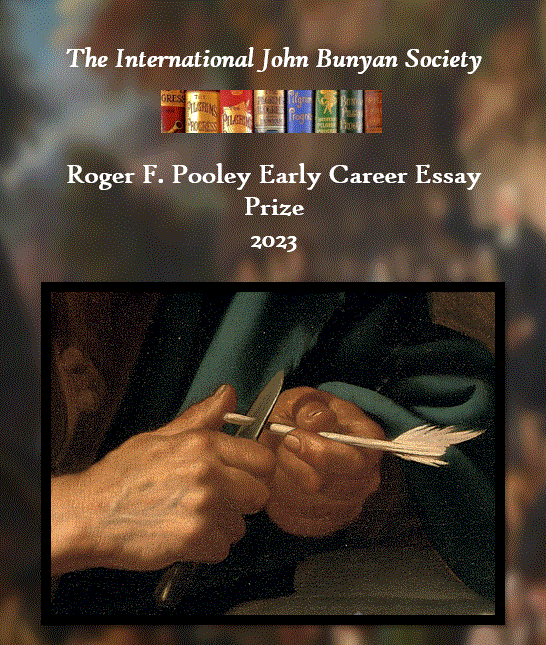
The International John Bunyan Society is pleased to announce that the 2023 Roger F. Pooley Early Career Essay Prize has been award to Richard Angelo Bergen for the essay “The Word and the World: Allegory and the Spatial ‘Nature’ of The Pilgrim’s Progress.” Richard’s winning entry was published in the 2022 issue of Bunyan Studies. The winner’s certificate and cash prize of £300 has been sent to Richard by Professor Shannon Murray, IJBS President. The selection committee was chaired by Bob Owens, and its members were Rachel Adcock, David Gay, and Arlette Zinck.
Richard is the current editor of The Recorder, the official newsletter of the IJBS. He recently completed his PhD at the University of British Columbia, and he works as an English instructor at Corpus Christi College in Vancouver, BC. He has won two Graduate awards from the Social Sciences and Humanities Research Council of Canada. His dissertation discussed the use of space and place in allegorical narratives, and his Bunyan Studies essay is part of a broader project on topography in the allegorical tradition, which Richard aims to fashion into a book. He is also at work on two other essays that pertain to Bunyan: an essay on Bunyan’s representation of mnemonics and his relationship to the Memory Arts tradition as well as a project on the “genre” of allegory, unpacking what it means when modern readers imagine The Pilgrim’s Progress as the fulcrum of allegory.
The annual Roger F. Pooley Early Career Essay Prize is open to all international PhD students and to post-doctoral researchers within the first two years after their viva. Applicants must be members of the IJBS. The prize is for outstanding scholarly work in the field of early modern religion and Dissent, including its literature, history, and reception.
The annual International John Bunyan Society (IJBS) Roger F. Pooley Early Career Essay Prize recognises the cutting-edge research of junior scholars in the field of early modern religion and dissent.
The competition is open to PhD students and post-doctoral researchers up to two years after their viva.
To be eligible, applicants MUST be members of the IJBS. Membership enquiries/ subscriptions can be made via the Society’s UK Treasurer: r.c.adcock@keele.ac.uk.
Applicants can submit an essay of up to 8,000 words (e.g. part of a chapter or a draft of an article or a written version of a conference paper) by 30 June 2023 (as an email attachment). The word count includes footnotes, but excludes title, bibliography and any appendixes (which, however, should not be longer than the text of the essay).
The name of the author, their affiliation and their role (e.g. final-year PhD student) as well as the word count should be indicated on the title page.
A brief biography outlining the applicant’s current research project (150 words) is to be included.
This year the IJBS particularly welcomes contributions discussing the emotional history, and history of emotions, of religious Dissenters during the Long Reformation (global perspectives are especially welcome). All submissions will be judged by members of the Society’s Executive Committee who may ask other experts to join them. Candidates will be informed of the outcome by email within a month of the submission date. The winner will be officially announced on 1 September 2023. The winner receives a certificate, a financial award of £300, one year’s free membership to IJBS and a year’s subscription to the Society’s peer-reviewed journal: Bunyan Studies.
Please send all submissions by 30 June 2023 to the Society’s General Secretary, Michael Arbino, via JohnBunyanSociety@outlook.com.
The International John Bunyan Society is pleased to announce that its newly renamed Roger F. Pooley Early Career Essay Prize has been awarded to Nathan Sherman (@nathansherman) for the essay: ‘The Wapping Baptists: The Varied Location of a Unified People’. The winner’s certificate and cash prize of £300 has been sent to Nathan by Professor Shannon Murray, IJBS President. The selection panel was chaired by David Gay, and its members were Rachel Adcock, Michael Davies and Naomi Pullin. Nathan’s winning entry will be published in the 2023 issue of Bunyan Studies: A Journal of Reformation and Nonconformist Culture.
Nathan Sherman is entering his third year of doctoral studies at the University of Leicester as a part-time, international researcher. He currently lives in Albuquerque, New Mexico in the U.S. where he is the pastor of a Baptist church. His research focusses on the congregational minute book of the Wapping Baptist church (1677-1711), as both a valuable window into the particular social and cultural realities of this east London people, but also as a significant literary artifact in and of itself.
The annual Roger F. Pooley Early Career Essay Prize is open to all international PhD students and to post-doctoral researchers within the first two years after their viva. Applicants must be members of IJBS. The prize is for outstanding scholarly work in the field of early modern religion and Dissent, including its literature, history and reception.
As part of the IJBS Blog Series, Dr Ariel Hessayon (@ArielHessayon), Reader in early modern History at Goldsmiths, University of London, explores the origins and legacies of the comical, controversial and anti-clerical Martin Marprelate pamphlets across the 16th-17th centuries.
Whereas Part One of this blog post examined the religio-political context of the Martin Marprelate tracts, Part Two explores the tracts themselves. The objective of the Martinists was, in a manner of speaking, to push the Church of England further away from Rome (Popery) and closer to Geneva (Calvinism). The middle way – as they saw it – that had been navigated in the form of the Elizabethan Religious Settlement, with its reintroduced Book of Common Prayer (1559) and modified Thirty-Nine Articles (1571), did not go far enough. Rather, the tightly knit and well-organised network of ‘Martinists’ responsible for the tracts wanted a separation of secular from ecclesiastical power, that is distinct spheres of influence for the magistracy and ministry. Moreover, they placed great emphasis on the Bible as the word of God, a divine word which had greater authority than traditions and the pronouncements of bishops. Indeed, it was high ranking ecclesiastical officials and academics – ‘petty popes, and petty antichrists’– that the Martinists initially had in their sights. Among them was a dean of Salisbury called John Bridge, who had written an exceptionally lengthy and tedious defence of the Church of England; the Archbishop of Canterbury; the Bishops of Winchester and London; and the master of a Cambridge College. This was at a time, it must be stressed, when printed works were strictly censored by the Archbishop of Canterbury, Bishop of London and those delegated by them for that purpose. And while there was no Inquisition in the manner of Catholic Spain, there was still a Court of High Commission for investigating and punishing those found guilty of committing religious offences. Mercifully, this court could not sanction torture to extract confessions nor could it impose the death penalty. It did, however, operate in tandem with the secular Court of Star Chamber, whose officials investigated and heavily fined some of those suspected of being involved in the Marprelate affair.
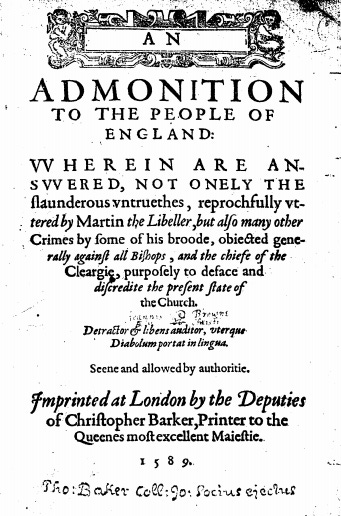
Frontispiece, An Admonition to the People of England(London, 1589).
The annual International John Bunyan Society (IJBS) Early Career Essay Prize recognises the cutting-edge research of junior scholars in the field of early modern religion and dissent.
As part of the IJBS Blog Series, Dr Ariel Hessayon (@ArielHessayon), Reader in early modern History at Goldsmiths, University of London, explores the origins and legacies of the comical, controversial and anti-clerical Martin Marprelate pamphlets across the 16th-17th centuries.
On 6 April 1593 the Cambridge-educated religious separatists Henry Barrow (c.1550–1593) and John Greenwood (c.1560–1593) were hanged for treason at Tyburn – a notorious site of execution outside the city of London. They had been found guilty of writing and publishing seditious literature with malicious intent. Just over a month later another Cambridge-educated religious dissident, the Welsh preacher and pamphleteer John Penry (1562/63–1593), was tried twice: firstly for inciting rebellion and insurrection, and then for attacking the Church of England through the publication of scandalous writings. Penry was found guilty and on 29 May 1593 likewise hanged, this time in Surrey. As for Penry’s co-conspirator, the Warwick MP Job Throckmorton (1545–1601), he too had been put on trial in 1590. In Throckmorton’s case this was a result of the government crackdown on Protestant dissenters suspected of being involved in the writing, publication and circulation of a series of texts issued under the pseudonym ‘Martin Marprelate’ and its subsequent variants. Throckmorton, however, pleaded innocence: ‘I am not Martin, I knew not Martin’ he claimed. And because of his relatively high social status and extensive connections, not to mention legal technicalities, Throckmorton escaped the fate that would befall Barrow, Greenwood and Penry. Instead he died in relative obscurity.
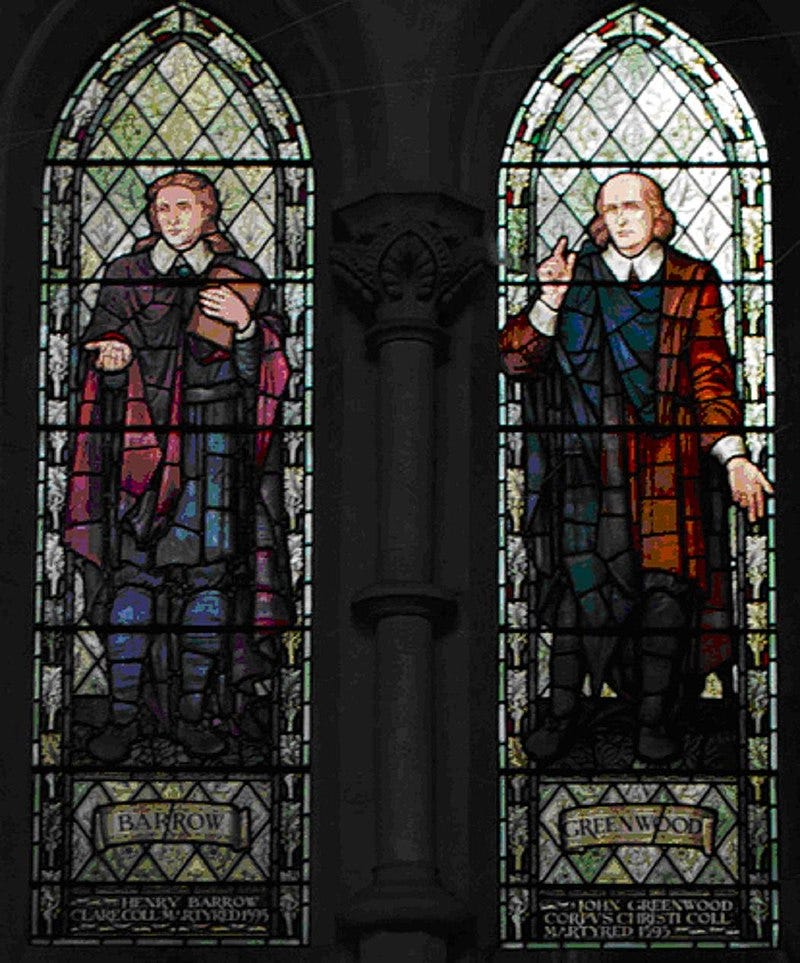
Stained glass windows at Emmanuel United Reformed Church, Cambridge depicting Henry Barrow [left] and John Greenwood [right].
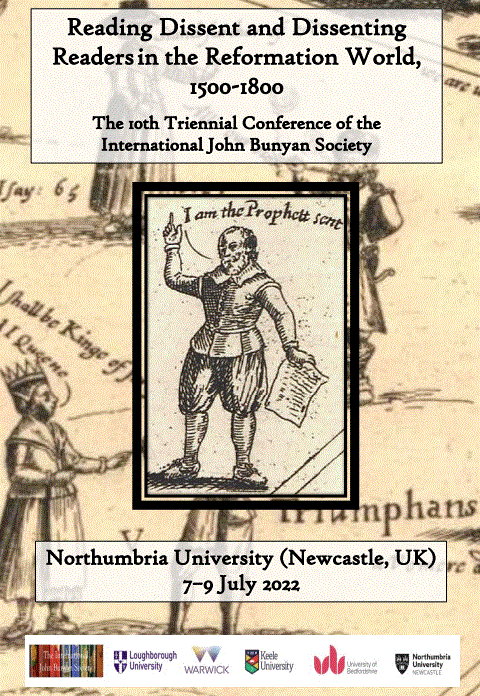
The 10th Triennial Conference of the International John Bunyan Society
Northumbria University, Newcastle (UK) 7–9 July 2022
REGISTRATION
Registration for the IJBS Triennial Conference is still open. Using the Conference Portal you can select your registration fee and add any optional extras, including accommodation and the Conference Dinner. Please note that both of these options have a limited number of spaces available and will therefore be allocated on a first come first serve basis.
FINAL PROGRAMME
The Final Conference Programme is also now available to view and download. Alongside the conference’s panels, plenaries and public lecture, a series of exciting excursions and activates has also been planned. If you need any further information, particularly regarding accessibility or travel, or have a question about the programme, please contact Dr Robert W. Daniel at IJBSSecretary@outlook.com.






 The International John Bunyan Society